Rice certifications GCC buyers require go beyond a single document — Gulf markets demand ISO 22000:2018, HACCP, Halal, and conformity certificates before any contract is signed. For B2B importers and procurement teams sourcing rice for these markets, understanding which certifications matter can prevent costly delays and rejected shipments.
GCC rice buyers typically require ISO 22000:2018, HACCP, Halal certification, and country-specific certificates of conformity before signing purchase agreements. Rice export contracts must also include product specifications and quality standards that define variety, broken percentage, moisture content, and inspection methods. Premium varieties like 1121 basmati rice often face additional documentation requirements tied to origin verification and grain purity.
Pakistan has emerged as a certified origin for international markets, with suppliers meeting ISO 9001:2015, ISO 22000:2018, HACCP, Halal, and USFDA standards. Understanding rice supplier certifications helps buyers secure consistent quality and build trust across supply chains. This guide breaks down the essential certifications GCC buyers need before committing to rice contracts.
Key Takeaways
- GCC buyers require ISO 22000:2018, HACCP, Halal certification, and conformity certificates before signing rice import contracts
- Rice export documentation must include measurable quality specifications, origin certificates, and inspection reports aligned with buyer requirements
- Certified suppliers from reliable origins help procurement teams reduce regulatory risk and ensure compliance across Gulf markets
Rice Certifications GCC Buyers Need for B2B Trade
GCC buyers evaluate suppliers based on internationally recognized food safety certifications that demonstrate systematic quality control and regulatory compliance. ISO 22000, HACCP, and FSSAI certifications form the foundation of credible rice trade relationships in regulated markets.
ISO 22000 and Food Safety Management Systems
ISO 22000 certification verifies that a rice supplier maintains a comprehensive food safety management system throughout the supply chain. This standard covers everything from paddy procurement to final packaging. It requires documented procedures for hazard identification, preventive controls, and continuous improvement.
GCC importers prioritize ISO 22000:2018 because it integrates HACCP principles with management system requirements. The certification demonstrates that suppliers monitor critical control points during milling, sorting, and storage. Pakistani rice suppliers holding ISO 22000 certification show buyers they can consistently deliver safe products that meet international standards.
Buyers benefit from reduced inspection requirements and faster customs clearance when working with ISO-certified suppliers. The certification also ensures traceability systems are in place, allowing buyers to track rice batches from origin to delivery.
HACCP and GMP Compliance
HACCP certification focuses specifically on identifying and controlling food safety hazards during rice processing. The system requires suppliers to establish critical control points for moisture content, temperature, pest control, and contamination prevention. HACCP compliance has become non-negotiable for suppliers serving GCC markets.
GMP certification ensures rice processing facilities follow proper hygiene practices, maintain clean equipment, and implement worker training programs. Together, HACCP and GMP create a complete framework for preventing contamination and maintaining product integrity.
Buyers verify that suppliers conduct regular internal audits and maintain updated HACCP plans. These certifications reduce the risk of product recalls and protect brand reputation in competitive markets.
FSSAI Approval for Indian Exporters
FSSAI certification is mandatory for rice exporters operating from India. The Food Safety and Standards Authority of India issues this certification to verify compliance with national food safety regulations. Indian suppliers must display FSSAI license numbers on all packaging and documentation.
GCC buyers sourcing from India require valid FSSAI registration as a baseline qualification. The certification confirms that processing facilities meet Indian government standards for hygiene, labeling, and quality control. Exporters must renew FSSAI licenses annually and maintain compliance records.
Buyers should verify FSSAI license validity through the official registry before finalizing contracts. This certification works alongside ISO and HACCP standards to provide comprehensive quality assurance for Indian-origin rice entering GCC markets.
Documentation Requirements for GCC Rice Imports
GCC rice imports demand precise documentation covering origin verification, agricultural safety, and transport logistics. Each document serves a distinct regulatory purpose and must be authenticated by recognized authorities before customs clearance.
Certificate of Origin and Legal Proofs
The certificate of origin confirms the country where rice was grown and processed. This document is issued by the chamber of commerce or authorized trade body in the exporting country. It validates that the rice originates from a specific nation and meets bilateral trade agreements between that country and GCC member states.
Pakistan holds recognized supplier status within GCC trade frameworks. Rice exporters from Pakistan obtain certificates through designated government agencies that verify production location and processing facilities.
Key elements on certificates of origin include:
- Full exporter and importer details
- Commodity description and HS code
- Net and gross weight declarations
- Processing facility location
- Authentication stamps and signatures
Legal proofs also include commercial invoices and packing lists. These documents must match exactly with information on the certificate of origin. Any discrepancy triggers inspection delays at GCC ports. Buyers verify these documents before finalizing contracts to ensure smooth customs processing.
Phytosanitary and Fumigation Certificates
Phytosanitary certificates confirm rice is free from pests and agricultural contaminants. The plant protection department in the exporting country issues these certificates after laboratory testing and facility inspection. GCC countries require phytosanitary documentation for all grain imports to protect local agriculture.
Fumigation certificates prove that rice shipments underwent chemical treatment to eliminate insects and microorganisms. This treatment typically occurs before shipping and must be performed by licensed fumigation operators.
Required fumigation certificate details:
- Chemical used and concentration levels
- Treatment duration and temperature
- Container or storage facility identification
- Date of fumigation and expiry
- Operator license number
Both certificates must be recent and align with shipment dates. GCC customs authorities reject expired documents or certificates issued too far in advance. Rice meeting ISO 22000:2018 and HACCP standards undergoes systematic pest control throughout processing, simplifying phytosanitary compliance.
Bill of Lading and Shipping Documentation
The bill of lading serves as the primary transport document and proof of ownership during shipment. It functions as a contract between the shipper and carrier, detailing cargo specifications and delivery terms. GCC rice imports require complete shipping documentation for customs clearance and cargo release at destination ports.
Bill of lading documents specify container numbers, seal numbers, and cargo weight. They identify the consignee and notify party for delivery coordination. Original bills of lading are required for cargo release unless alternative arrangements are made through express release or seaway bills.
Essential shipping documents include:
- Original bill of lading (three copies)
- Cargo insurance certificate
- Packing list with container details
- Weight certificates from independent surveyors
Documentation accuracy directly impacts clearance speed. Buyers verify that the bill of lading matches purchase order quantities and container specifications before accepting shipment responsibility. Missing or incorrect shipping documents result in port storage fees and delayed market entry.
Role of Conformity Assessment Bodies (CABs)
Conformity Assessment Bodies perform critical third-party verification to confirm rice shipments meet GCC technical regulations before contracts are finalized. These bodies also manage the digital submission of compliance documentation through regional trade portals that GCC customs authorities monitor.
Verification of Compliance
CABs conduct independent audits of rice suppliers to verify adherence to Gulf Technical Regulations and international standards. These organizations inspect facilities, review production processes, and test product samples against specified requirements for food safety and quality.
Key verification activities include:
- Physical inspection of rice batches for contaminants and quality parameters
- Review of ISO 22000:2018 and HACCP certification documentation
- Laboratory testing for moisture content, grain length, and broken grain percentage
- Halal certification validation for GCC market requirements
Pakistani rice suppliers working with exporters like TEFT Global maintain ongoing relationships with accredited CABs to ensure continuous compliance. The verification process typically takes 5-10 business days depending on the scope of assessment. CABs issue certificates of conformity that buyers require before releasing payment or accepting shipments at GCC ports.
Integration With Regional Portals (e.g., SABER)
CABs registered with Gulf authorities upload verification results directly into platforms like SABER (Saudi Arabia) and other GCC conformity tracking systems. This digital integration eliminates paper-based documentation delays and allows customs officials to verify shipment compliance in real time.
Exporters must ensure their CAB has active registration status within the destination country’s system. The assessment body submits test reports, certificates, and product specifications through the portal before goods arrive at port. GCC customs authorities cross-reference this uploaded data with physical shipments during clearance.
Portal integration requirements:
- CAB must hold valid accreditation from Gulf Cooperation Council Accreditation Centre
- Digital certificates linked to specific shipment batch numbers
- Real-time status updates visible to importers and customs
This streamlined process reduces clearance times from weeks to days for compliant rice shipments entering GCC markets.
Quality Standards and Grain Specifications
GCC buyers evaluate rice against measurable grain characteristics, laboratory verification protocols, and packaging compliance before finalizing contracts. These specifications determine customs clearance speed, shelf life performance, and market positioning across retail and institutional channels.
1121 Basmati Rice: Characteristics and Global Demand
Grain length must measure between 8.20–8.40 mm before cooking for premium classification. Pakistan produces certified 1121 Basmati varieties that meet this specification consistently through controlled cultivation zones.
Broken grain percentage affects pricing and visual appeal. GCC contracts typically specify:
- 1–2% broken: Premium retail grade
- 3–5% broken: Standard wholesale grade
- Above 5% broken: Industrial or budget grade
Moisture content between 12–14% prevents spoilage during transit and storage. Golden Sella variants maintain stability for 18 months in temperatures reaching 40°C, while Steam varieties require consumption within 12 months.
Elongation ratio after cooking should reach 2.0–2.2 times the original length. This characteristic separates authentic basmati from hybrid varieties. Buyers verify this through pre-shipment samples before committing to bulk orders.
Lab Testing and Traceability

Third-party laboratory certification validates grain specifications before shipment. ISO 22000 compliance ensures food safety management throughout the supply chain.
Required tests include:
- Moisture meter calibration results
- Broken percentage optical grading
- Pesticide residue screening
- Aflatoxin contamination levels
- Heavy metal detection
Traceability documentation connects paddy origin to final container loading. Each lot receives a batch number linking cultivation zone, milling date, and processing facility. This system enables rapid response if quality issues emerge at destination ports.
GCC buyers request SGS or equivalent inspection reports that match physical cargo specifications. Certificates must reference the actual container numbers and seal verification to prevent document fraud.
Packaging and Private Labelling Compliance
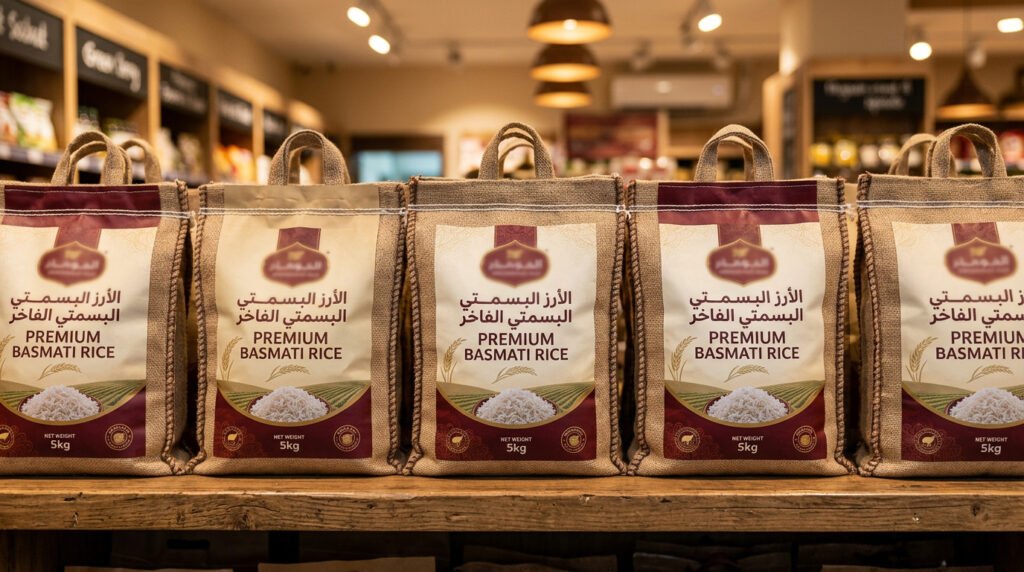
GCC labelling standards for Qatar in 2026 require Arabic translation, nutritional panels, and country of origin declarations. Packaging materials must meet food-grade certification.
Standard formats for rice export include:
| Package Size | Application | Material |
|---|---|---|
| 5 kg bags | Retail consumer | Printed PP |
| 10 kg bags | Small wholesale | Woven HDPE |
| 25 kg sacks | Institutional | Laminated PP |
| 40 kg bags | Bulk distribution | Heavy-duty woven |
Private label requirements demand brand-specific artwork approval, barcode registration, and batch coding systems. Suppliers must demonstrate capacity for custom printing without cross-contamination between client brands.
Halal certification logos require proper licensing and cannot be applied without authorized documentation. USFDA registration numbers must appear on packaging destined for North American re-export markets.
GCC-Market-Specific Export Requirements
Each GCC member state enforces distinct import regulations while sharing regional standards through the GCC Standardization Organization conformity assessment framework. Rice exporters must navigate country-specific documentation alongside the G-Mark certification system that validates product compliance across Gulf markets.
Country Regulations and G-Mark Overview
The G-Mark certification serves as the official conformity marking for products entering GCC markets. This certification indicates that rice packaging and labeling meet mandatory Gulf Technical Regulations. Manufacturers must complete risk analysis assessments and maintain proper documentation before products receive approval.
Rice packaging and labeling for Qatar requires certifications including ISO standards, HACCP compliance, phytosanitary certification, and conformity with GCC food safety regulations. These certifications validate that products meet international and regional quality benchmarks. Pakistani rice suppliers meeting ISO 9001:2015, ISO 22000:2018, HACCP, Halal, and USFDA standards position themselves as reliable partners for GCC importers.
The GCC imported foods control guide outlines risk-based food control systems and documentation requirements like health certificates. Specific health attestations apply to processed foods and plant-based products. Halal slaughtering attestations and GCC-specific standards ensure compliance across member states.
Regional Buyer Preferences and Trends
GCC buyers prioritize suppliers who demonstrate consistent quality through recognized international certifications. Qatar-based importers serving both GCC and international markets seek partners with comprehensive certification portfolios that simplify customs clearance.
Exporting to GCC countries requires specific documentation to comply with trade laws and ensure smooth customs processing. Buyers prefer working with exporters who maintain current certifications and understand regional enforcement variations. Language requirements and labeling standards differ between member states, making local market knowledge valuable.
Pakistani rice exporters who maintain USFDA certification alongside regional requirements appeal to buyers serving diverse international markets. This certification depth reduces compliance risks and streamlines distribution across multiple territories. Buyers increasingly request digital tracking capabilities and transparency throughout the supply chain.
Contractual and Trade Best Practices for Exporters
Rice exporters must define product standards in measurable terms and include verifiable sourcing commitments to protect both parties and maintain regulatory compliance throughout the supply chain.
Aligning Product Specifications With Buyer Claims
Contracts should describe rice in measurable terms, not marketing labels. This prevents disputes during inspection and payment.
Key specifications to include:
- Grain dimensions: Length, width, and elongation ratio after cooking
- Broken grain percentage: Maximum allowable percentage by weight
- Moisture content: Specific percentage range at delivery
- Milling degree: Extent of bran removal and polish level
- Sortex quality: Foreign matter and discolored grain limits
Pakistan produces certified basmati and non-basmati varieties that meet these technical parameters consistently. Rice exporters must reference specific quality standards like Codex Alimentarius or national grading systems rather than subjective descriptions.
The contract must state which party conducts quality testing and at what point. It should also specify whether inspections occur before shipment or upon arrival. This clarity reduces payment delays and rejection risks.
Ethical Sourcing and Sustainability in Agreements
GCC buyers increasingly require documented proof of ethical sourcing practices before finalizing contracts. Rice exporters must demonstrate compliance with labor standards and environmental protocols.
Essential documentation includes:
- Factory audit reports showing worker safety and fair wages
- Water management certifications for cultivation regions
- Pesticide residue testing below GCC maximum residue limits
- Chain of custody records from farm to mill
Contracts should specify that all rice originates from certified suppliers meeting ISO 22000:2018 food safety management standards. Pakistani rice mills with HACCP and Halal certifications provide traceability documentation that satisfies these requirements.
Sustainability clauses protect buyers from regulatory changes and reputational risks. Rice exporters who include greenhouse gas reduction commitments and sustainable packaging options gain competitive advantages in long-term supply agreements with GCC distributors.
Importance of Certification in Building Trust and Market Access
Certifications provide buyers with verified proof that suppliers meet international quality and safety benchmarks. They reduce uncertainty in cross-border transactions and open doors to regulated markets that demand compliance.
Reputation in International Markets
Rice supplier certifications establish credibility with buyers who need assurance before committing to long-term contracts. GCC buyers evaluate suppliers based on their ability to consistently meet standards like ISO 22000:2018 and HACCP.
Pakistani rice exporters who maintain these certifications gain a competitive advantage in international markets. Certified suppliers demonstrate adherence to strict hygiene protocols, traceability systems, and quality control measures that align with GCC import requirements.
Certification benefits for market reputation include:
- Documented proof of food safety management systems
- Third-party verification of production processes
- Enhanced brand recognition among institutional buyers
- Faster approval for government and private sector contracts
Buyers in the GCC region prioritize suppliers with multiple certifications because it signals operational maturity and risk management capabilities.
Reducing Trade and Compliance Risks
Certifications help businesses ensure product quality, safety, and compliance while minimizing the risk of shipment rejection at ports of entry. GCC countries enforce strict import regulations that require documentation proving compliance with food safety standards.
Suppliers certified under ISO 9001:2015, Halal, and USFDA standards face fewer delays during customs clearance. These certifications reduce the likelihood of costly recalls, legal disputes, or contract cancellations due to quality failures.
Risk mitigation through certification:
- Prevents regulatory violations that lead to financial penalties
- Reduces inspection frequency at border checkpoints
- Provides legal protection through documented compliance
- Minimizes contamination risks through verified food safety management systems
Market access becomes significantly easier when suppliers hold recognized certifications that match buyer requirements. This is particularly important for Pakistani rice exporters entering GCC markets where certification is often mandatory before contract signing.
Frequently Asked Questions
GCC buyers require specific documentation standards before finalizing rice import contracts. These requirements cover food safety systems, plant health clearances, religious compliance, laboratory verification, packaging specifications, and certificate validation procedures.
Which food safety management certificates do importers in GCC countries typically expect from rice suppliers?
GCC importers require rice suppliers to hold current ISO 22000:2018 certification, which demonstrates a comprehensive food safety management system covering the entire supply chain. This standard combines HACCP principles with quality management requirements and is considered essential for professional rice exporters serving Gulf markets.
ISO 9001:2015 certification is also expected by most GCC buyers. This quality management system standard ensures documented processes for consistency, traceability, and continuous improvement across rice milling operations.
HACCP certification serves as the baseline requirement. The certificate must specifically list rice milling, processing, and export within its scope to be valid for GCC contract purposes.
GMP (Good Manufacturing Practice) certification is frequently requested alongside HACCP. It covers facility hygiene, pest control programs, staff training protocols, and equipment maintenance records that GCC inspectors review during supplier audits.
Pakistani rice mills supplying the GCC market typically maintain all four certifications simultaneously. Buyers verify that certificates are issued by internationally recognized bodies such as SGS, Bureau Veritas, NSF, or MASCI.
What phytosanitary documents and plant health certificates are required for rice shipments entering GCC ports?
Every rice shipment entering GCC countries requires a Phytosanitary Certificate issued by the plant protection authority of the exporting country. For Pakistani rice, this certificate comes from the Department of Plant Protection under Pakistan’s Ministry of National Food Security and Research.
The certificate confirms that the rice has been inspected and found free from quarantine pests, plant diseases, and weed seeds. It must reference the specific IPPC (International Plant Protection Convention) treatment code if fumigation was performed.
A Fumigation Certificate is mandatory for most GCC destinations. The document must specify the fumigant used (typically aluminum phosphide or methyl bromide), dosage, exposure duration, and treatment date.
GCC customs authorities cross-reference the phytosanitary certificate number with the commercial invoice and bill of lading. Any mismatch in container numbers, net weight, or consignee details triggers immediate inspection holds at the port.
Saudi Arabia requires phytosanitary certificates to be authenticated by the Saudi embassy or consulate in the exporting country before shipment. UAE and other GCC states accept certificates without prior embassy authentication but reserve the right to conduct port inspections.
What halal-related documentation is requested for rice, and when is it mandatory versus optional?
Halal certification is legally mandatory for all food products entering Saudi Arabia, Kuwait, and UAE. Rice requires halal certification for Muslim-majority markets even though it contains no animal-derived ingredients, because the certification verifies the entire production environment remains free from cross-contamination with prohibited substances.
The certificate must be issued by an Islamic authority recognized by the importing GCC country. For Pakistani rice, acceptable certifying bodies include the Pakistan National Accreditation Council (PNAC) recognized Halal certification bodies and international certifiers approved by Gulf standards authorities.
Qatar, Bahrain, and Oman do not legally mandate Halal certificates for rice imports. However, major retailers and food service distributors in these markets routinely request Halal documentation as part of their supplier qualification process.
The Halal certificate must clearly state the product description (basmati rice, IRRI-6, or other varieties), the manufacturing facility address, the certificate number, and validity dates. Certificates are typically valid for one year and require annual renewal audits.
GCC buyers verify Halal certificates through the issuing authority’s online portal or direct contact. Fraudulent Halal certificates are a documented problem in commodity trade, making verification a standard contract requirement.
Which laboratory test reports are commonly required to verify pesticide residues, heavy metals, and microbiological safety in rice?
A Certificate of Analysis from an accredited third-party laboratory is required for nearly all GCC rice import contracts. The report must come from a lab holding ISO/IEC 17025 accreditation and recognized by the importing country’s food safety authority.
Pesticide residue testing must cover organophosphates, pyrethroids, and carbamates commonly used in rice cultivation. GCC standards follow Codex Alimentarius maximum residue limits (MRLs) or establish stricter national standards through GSO (GCC Standardization Organization) technical regulations.
Heavy metal analysis must test for lead, cadmium, arsenic, and mercury. Arsenic testing for rice requires speciation analysis distinguishing between inorganic arsenic (the toxic form) and organic arsenic compounds, as GCC regulations increasingly adopt limits on inorganic arsenic specifically.
Microbiological testing covers total plate count, E. coli, Salmonella, mold, and yeast. The lab report must state the test methods used (typically ISO or AOAC methods) and detection limits for each parameter.
Moisture content, broken grain percentage, foreign matter, chalky kernels, and aflatoxin levels are also standard test parameters. For basmati rice, the Certificate of Analysis includes average grain length and elongation ratio after cooking.
SGS, Bureau Veritas, Intertek, and other internationally accredited labs operate testing facilities in Pakistan and throughout Asia. Reports are typically valid for the specific lot tested and must match the lot numbers on the commercial invoice and packing list.
What packaging and labeling compliance documents are needed to meet GCC standards, including Arabic labeling requirements?
All retail packages of rice entering GCC countries must display labels in Arabic alongside English or other languages. The Arabic text must include the product name, net weight, country of origin, manufacturing and expiry dates, and the importer’s contact information within the GCC country.
GSO 9:2013 standard specifies labeling requirements for prepackaged foodstuffs across all GCC member states. Rice labels must show nutritional information (energy, protein, carbohydrates, fat, sodium) per 100 grams and per serving size.
A label approval certificate from the importing country’s food authority is required before the first shipment. Saudi Arabia requires SFDA label approval, UAE requires ESMA approval, and each GCC country maintains its own pre-market approval process for food labels.
Packaging material declarations verify that bags, liners, and printing inks meet food-grade safety standards. The supplier provides technical data sheets confirming packaging materials comply with FDA or EU regulations for food contact materials.
Sourcing rice for GCC markets and need a supplier with the full certification stack? TEFT Global holds ISO, HACCP, and Halal certification across our Pakistani rice range — with complete documentation ready for every shipment.